
eDNA Testing Services in the UK
Fast, Accurate, Cost-Effective Species Detection for
Planning, BNG & Ecological Compliance

Full Membership
Fully Licenced

Fully Insured

ICO Compliant
At The BNG Guy, we provide industry-leading eDNA testing services to support planning applications, BNG requirements, protected species assessments & long-term ecological monitoring across the UK.
Environmental DNA (eDNA) testing has rapidly become one of the most reliable, scalable and cost-effective ways to detect species in water, soil and sediment—especially protected, elusive or hard-to-survey species.
By partnering with the UK’s leading forensic lab, SureScreen, we continue being the UK’s leading eDNA ecology consultancy. Thanks to recent science and our partnership, we can now sample eDNA for a range of aquatic and terrestrial organisms even very small populations, including for great crested newts, white-clawed crayfish, water voles, fish and bat species identification.
Whether you’re a developer, planning consultant, land agent or local authority, we deliver fast, scientifically robust results using UK-approved testing methods and accredited laboratories.

Species Detection
We can confirm species presence without needing to see, capture or disturb them, making it an ideal tool for:

Did you know?
We were one of the very first ecology companies to use Environmental Science in the UK
Environmental DNA can determine the sex of a bird from a feather or eggshell
eDNA for newts is typically 30x faster than traditional methods
eDNA insights
Learn more about the protected species, survey case studies, current protected species policies and what the future for our natural world looks like.
Understanding eDNA Testing: Your Complete Guide to Environmental DNA

Fully Accredited
We’re fully accredited, licenced and insured. Our experienced ecologists are full members of CIEEM, licenced by Natural England and are covered by comprehensive insurances.
Fast & Reliable

Recommended

100% Success
Environmental DNA (eDNA testing) detects genetic material shed by organisms into water, soil or air. This non-invasive molecular technique identifies presence or absence of species from trace DNA, delivering highly sensitive biodiversity data without the need for direct observation or capture.
✔ Highly accurate species detection
eDNA testing consistently outperforms many traditional survey methods for detecting rare, cryptic or low-density species. Advanced laboratory workflows and validated assays reduce false negatives and increase confidence in species records, making eDNA ideal for conservation surveys, impact assessments and post-development monitoring.
✔ Fast turnaround times
Field sampling for eDNA testing is rapid and straightforward: trained technicians can collect multiple samples in a single site visit. Accredited laboratories offer streamlined processing and qPCR or metabarcoding workflows that shorten analysis time, enabling quicker decision-making during planning and construction phases.
✔ Cost-effective multi-species surveys
One eDNA sample can screen for multiple target species simultaneously, or be processed via metabarcoding to profile entire communities. This reduces field effort, specialist survey hours and the need for repeat visits—delivering better value compared with many species-specific traditional surveys.
✔ Planning and regulatory compliance
eDNA testing is increasingly accepted by UK planning authorities and statutory consultees. Robust eDNA surveys support compliance with key legislation and policy, including:
- Environment Act 2021 biodiversity measures
- Biodiversity Net Gain (BNG) reporting and baseline assessments
- Local Biodiversity Action Plans and conservation strategies
- Habitat Regulations Assessments and impact screening
- Natural England protected species guidance where applicable
Delivering defensible data aligned with regulatory expectations, eDNA testing helps streamline planning submissions and reduce uncertainty during ecological risk assessments.
✔ Minimal disturbance, maximum coverage
Because eDNA testing does not require trapping, netting or handling of animals, it minimizes disturbance to sensitive habitats and protected species. The method is especially useful in areas with restricted access, protected sites, or where traditional survey techniques are impractical or harmful.
✔ Scalable and repeatable monitoring
eDNA testing enables consistent, repeatable monitoring across multiple sites and time points. This scalability supports pre-construction baseline surveys, seasonal monitoring, mitigation effectiveness checks and long-term biodiversity studies, providing clear temporal datasets for adaptive management.
✔ Suitable for a wide range of environments
From ponds, rivers and wetlands to soil and sediment samples, eDNA testing works across diverse environments. Protocols can be tailored to target freshwater species (e.g., great crested newt, fish, amphibians), invasive non-native species or whole-community assessments using metabarcoding approaches.
Best practice and quality assurance
Reliable eDNA testing follows strict field and laboratory protocols, including contamination controls, sample storage standards and validated assays. Choose providers that adhere to accreditation, offer robust QA/QC, and provide clear interpretive reports that integrate with ecological and planning advice.
Get started with eDNA testing
Integrating eDNA testing into your project reduces survey time, costs and ecological impact while improving species detection and regulatory confidence. Contact an experienced eDNA provider to design a targeted sampling strategy, agree on species or metabarcoding panels, and receive actionable results that support planning, mitigation and conservation outcomes.
Frequently Asked Questions About eDNA
Is eDNA testing accepted by UK planning authorities?
Yes. Natural England, DEFRA and most local planning authorities accept eDNA testing when used correctly.
Can eDNA replace traditional surveys?
Sometimes—but not always. For some species, eDNA proves presence/absence but not population size. We advise on the best approach case-by-case.
When is eDNA most useful?
Large sites
Time-restricted surveys
Early site screening
Waterbody assessments
BNG baseline monitoring
How long do results take?
Typically 5–10 working days depending on sampling, lab demand and report requirements.
So, you’ve submitted your planning application—and now the local planning authority has requested an eDNA testing report. If the term “edna testing” is new to you, you’re not alone. Environmental DNA (commonly written as eDNA) is a fast-growing, scientifically robust method used by ecologists and planning officers to detect the presence of species from traces left in water, soil or sediment.
This expanded guide explains edna testing in plain English, outlines why planning authorities request it, and describes what the results mean for your development. We focus on practical steps, typical timelines and costs, and how edna testing fits with other protected species surveys so you can make informed choices for your project.
What is edna testing?
edna testing analyses tiny fragments of DNA that organisms shed into their environment—through skin cells, faeces, urine or mucous. Scientists collect environmental samples (usually water or soil), extract DNA, and use targeted lab techniques to identify which species are or were recently present. Because edna testing can detect elusive or low-density species that are difficult to find with traditional survey methods, it’s increasingly used in planning and biodiversity assessments.
Why planning authorities request edna testing
Local planning authorities request edna testing when there is potential for protected or priority species (for example great crested newts, freshwater mussels or certain fish) to be affected by proposed development. An edna testing report provides objective evidence about presence or absence, helping determine whether further ecological mitigation or licensing is required. Using edna testing early can speed up planning decisions by providing clear data instead of lengthy repeat surveys.
Which species can be detected using edna testing?
Common targets in planning contexts include great crested newts (Triturus cristatus), crucian carp and other fish, certain amphibians, invasive species and some invertebrates. The range of species detectable by edna testing continues to expand as laboratories validate new assays. If you’re unsure whether edna testing can detect a species of concern on your site, an ecologist can advise.
How the edna testing process works (step-by-step)
1. Desktop appraisal: An ecologist reviews maps, local records and site history to decide whether edna testing is appropriate.
2. Survey design: The ecologist selects sample locations, timing and sample numbers to meet statutory guidance and laboratory requirements.
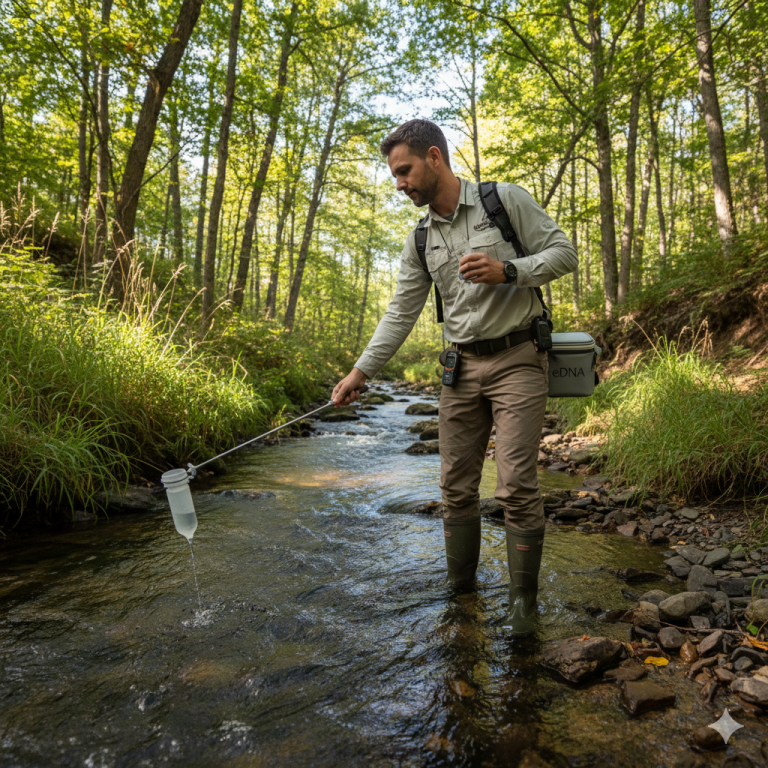
3. Field sampling: Trained surveyors collect water or soil samples using sterile techniques to avoid contamination. Multiple replicates and field controls are usually taken.
4. Laboratory analysis: Samples are filtered and DNA extracted. PCR (polymerase chain reaction) assays, quantitative PCR or metabarcoding are used to detect target species’ DNA.
5. Reporting: Results are interpreted by ecologists and presented in a report that explains findings, confidence levels and recommended next steps for planning submissions.
Typical timelines and seasonal considerations
edna testing is often quicker than repeated traditional surveys, but timing matters. For aquatic species like great crested newts, sampling windows are seasonal (commonly spring to early summer). From field sampling to laboratory results and report issuance typically takes 2–4 weeks, though this can vary with lab workload and assay complexity. Early engagement with an ecologist helps schedule sampling to meet planning deadlines.
Costs and value for developers
Costs for edna testing vary by species targeted, sample numbers and whether field visits are needed. In many cases edna testing is cost-effective compared with multiple site visits required for traditional surveys. Importantly, a single definitive edna result can reduce uncertainty, avoid delayed planning conditions and inform mitigation strategies—potentially saving time and money during the planning process.
How edna testing relates to other protected species surveys
edna testing is a powerful detection tool but is often used alongside conventional surveys. If edna testing indicates presence of a protected species, follow-up methods (e.g., site scoping, trapping, habitat assessment) may be required to determine population size, precise locations and appropriate mitigation. Conversely, a negative edna result can reduce the need for costly or intrusive additional surveys.
Preparing for edna testing: practical tips
- Engage an experienced ecologist early in the design stage to assess the need for edna testing and agree timing with planners.
- Provide access to ponds, watercourses or areas of interest and any historical ecological reports or records you have.
- Avoid activities that could contaminate sample sites (e.g., moving between ponds without decontaminating equipment) before sampling.
- Allow sufficient time in your planning programme for sampling, lab analysis and report preparation.
Interpreting edna testing results
edna testing reports will state whether target species’ DNA was detected and include confidence statements and any limitations. A positive detection confirms recent presence and will usually trigger mitigation planning or licensing. A negative detection reduces the likelihood of presence but must be interpreted alongside survey design quality, sample numbers and environmental conditions. Qualified ecologists explain practical implications and next steps in plain language for planning submissions.
Regulation, standards and best practice
High-quality edna testing follows recognised protocols and guidance from statutory bodies and professional ecological organisations. Ensure your ecologist and laboratory use validated assays, maintain strict biosecurity to prevent contamination, and document chain-of-custody for samples. Reports aligned with planning guidance carry more weight with local planning authorities.
Next steps for your planning application
If you’ve been asked for edna testing, contact a qualified ecologist to scope the requirement, design the survey and coordinate laboratory analysis. Early commissioning allows sampling in the correct season, reduces the risk of conditional planning delays and provides solid evidence for your application. For guidance on protected species surveys alongside edna testing, see our protected species overview: protected species.
Need help arranging edna testing or interpreting results for your planning application? Contact an ecologist with proven planning experience to get clear advice and a bespoke survey plan tailored to your site and timetable.