
What is the Small Sites Metric (SSM)?
The Small Sites Metric (SSM) is a streamlined calculation tool introduced by the Department for Environment, Food & Rural Affairs (Defra) to assist developers, designers, and planners involved in smaller development projects. This tool is crucial for ensuring compliance with Biodiversity Net Gain (BNG) requirements. Instead of utilizing the full Statutory Biodiversity Metric (SBM), which is more complex and suited for larger or intricate sites, the SSM provides a simplified approach tailored for small sites, where many complexities—such as various habitat types and priority habitats—can be minimised.
Despite its simplicity, the SSM achieves the same fundamental goal: it calculates the biodiversity units lost versus gained, determining if the development will leave the environment in a better state than before. Typically, this involves achieving a minimum 10% gain, as mandated by the Environment Act 2021 and related guidelines. By using the SSM, developers can easily assess the ecological impact of their projects, ensuring that the biodiversity value is enhanced, whether for residential developments, commercial developments, or smaller projects.
Local Planning Authorities (LPAs) will often require developers to use the small sites metric for planning applications involving sites less than 1 hectare, making it essential for projects that aim to create or enhance habitats on their development site. The SSM allows for a straightforward calculation of biodiversity, which must adhere to the statutory BNG requirements. This includes the calculation of biodiversity units, the baseline assessment, and the retention of existing habitats, all while ensuring that the new or proposed habitats contribute positively to the overall ecological landscape.
For smaller developments, the SSM serves as a vital tool to comply with the statutory biodiversity metric calculation tool, aiding in the creation of sustainable environments that meet both ecological and planning standards. Developers must be able to demonstrate their compliance through a competent person, often an ecologist, who can validate the calculations and the ecological benefits of the proposed developments, ensuring that they align with the objectives set forth by Natural England and other regulatory bodies.
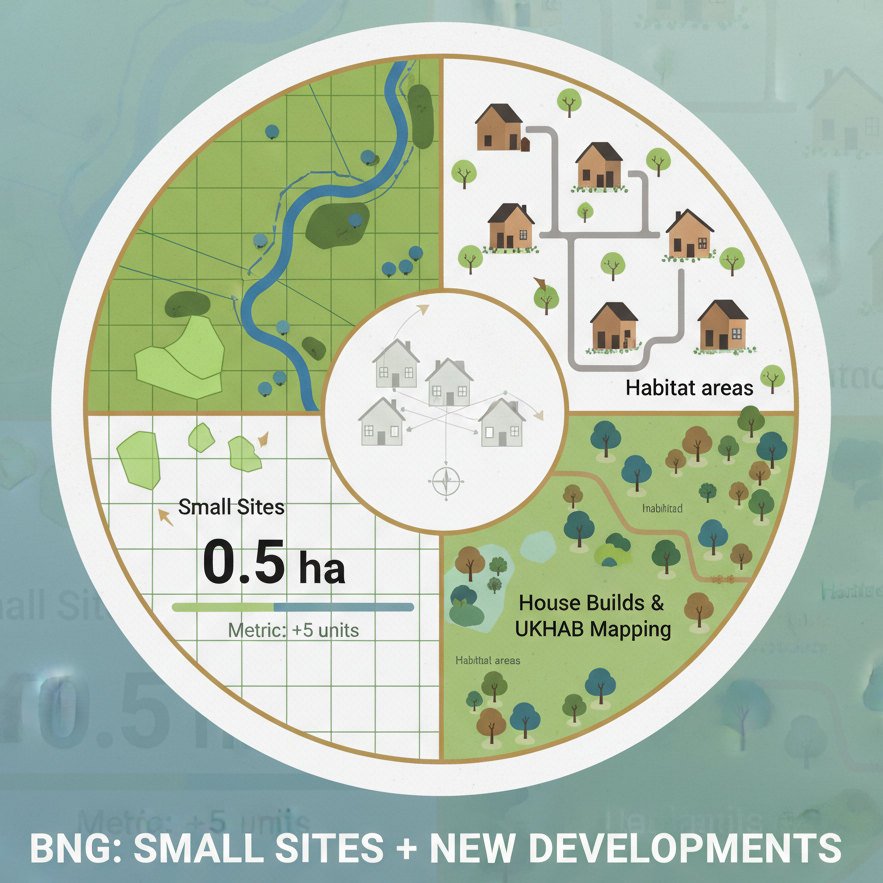
Why Does the Small Sites Metric Exist?
Here are the key motivations behind introducing the Small Sites Metric (SSM):
• To reduce the burden for smaller developments: many small-scale developments, such as those involving less than 1 hectare, often have simpler ecological and habitat issues. Therefore, a simplified version of the statutory biodiversity metric is more proportionate and easier to apply.
• To facilitate earlier and easier integration of biodiversity net gain (BNG) thinking into smaller projects. By using the SSM early in the design phase, small site developers can effectively incorporate nature-friendly design and ensure their projects enhance the environment in a better state.
• To ensure fairness: even smaller sites are now subject to BNG requirements (effective from April 2024 for many small developments), and the SSM provides a workable tool for achieving these statutory biodiversity metrics.
• To provide clarity on eligibility: the SSM clearly defines when small sites can use the simpler metric and when they must revert to the full statutory biodiversity metric. This helps local planning authorities (LPAs) and developers understand compliance requirements.
In short, as “The BNG Guy,” if you’re advising small-scale developers (for example, those planning 1-9 dwellings or small commercial developments), the SSM is often the right tool to use. However, it’s important to note the caveats and ensure that the calculation of biodiversity units aligns with the baseline assessment and existing habitats on the development site.
When Can You Use the SSM? (Eligibility)
Knowing whether it’s appropriate to use the SSM is crucial. The guidance sets out the eligibility criteria in detail.
1. Development Size
The definition of a “small site” aligns with the planning definition of not being categorized as a “major” development. This is crucial for developers looking to comply with biodiversity net gain (BNG) requirements.
• For residential developments: the site must accommodate between 1 to 9 dwellings on a site measuring 1 hectare or less. If the number of dwellings is uncertain, the site area should be less than 0.5 hectares. This is vital for using the small sites metric (SSM) effectively in biodiversity assessments.
• For commercial developments: the total floor space created should be less than 1,000 m², or the total site area must be less than one hectare. Utilizing the statutory biodiversity metric calculation tool can help in determining compliance with these parameters.
• The site must not be designated for the winning and working of minerals, nor for waste development. Developers must ensure that their proposed habitats enhance the existing environment and contribute positively to biodiversity value.
2. Habitat / ecological constraints
Even if your development meets the size threshold, you must still check whether you can effectively use the small sites metric (SSM) given ecological constraints. The SSM cannot be utilised if:
• There are priority habitats on site (with some exceptions such as certain hedgerows or arable field margins).
• There are statutory protected sites or habitats present.
• There are European protected species on site.
• The site contains habitat types not included in the SSM tool.
In such cases, you must revert to the full statutory biodiversity metric (SBM).
3. Use of the tool is optional (but often beneficial)
Even if eligible, you can use the main metric tool instead of the SSM if you prefer greater detail or the site is borderline. Guidance confirms you do not have to use the SSM in all eligible cases.
4. Off-site units / trading
The SSM tool does not have a built-in off-site module (unlike the full metric) for trading biodiversity units off-site. If off-site units are required you still start with SSM for on-site, then you’d need to link to the full metric for off-site.
5. Timing and applicability
BNG became mandatory for many large (major) developments earlier; from 2 April 2024, BNG requirements (and hence use of SSM for small sites) came into effect for many small developments.
How Does the SSM Work? (Summary of Process)
Here’s how the Small Sites Metric is structured and applied.
1. Baseline (‘pre-development’) assessment
You need to document the existing habitats on your development site before any construction begins, following the guidelines outlined in the Small Sites Metric (SSM) modules. This includes recording area habitats, hedgerows or lines of trees, and watercourses, along with their relevant attributes such as distinctiveness, condition, and strategic significance. It’s important to note that the SSM offers a streamlined approach compared to the full statutory biodiversity metric, where condition values are often fixed rather than tailored for each specific case.
Utilising the small sites metric is essential for developers aiming to comply with biodiversity net gain (BNG) requirements. By accurately calculating biodiversity units and assessing existing habitats, you can achieve the required biodiversity value. The SSM is particularly useful for smaller projects, including residential developments that cover less than 1 hectare, as well as small-scale commercial developments.
When preparing your planning application, local planning authorities (LPAs) may require you to implement a biodiversity assessment that meets statutory BNG standards. This includes using the statutory biodiversity metric calculation tool to ensure that you meet the biodiversity unit value necessary for compliance. If your development site is less than 0.5 hectares, it is crucial to use the simplified version of the statutory biodiversity metric to streamline the process.
For successful completion of your project, ensure that you engage a competent ecologist or consultant to assist in the measurement of biodiversity and the creation or enhancement of habitats on your site. This collaboration will help you retain existing habitats and plan for proposed habitats that enhance the environment in a better state post-development.
In summary, the small sites metric is a vital tool for developers looking to navigate the complexities of biodiversity assessment, ensuring that smaller developments meet the necessary ecological standards while contributing positively to biodiversity and habitat retention.
2. Post-development (proposed) assessment
To effectively utilise the small sites metric, developers must first assess the existing habitats on their development site. This involves detailing what will be retained, created, enhanced, or lost post-development. By using the statutory biodiversity metric calculation tool, the biodiversity units value can be accurately calculated after the development is completed.
The small sites metric is particularly beneficial for smaller projects and residential developments that are less than 1 hectare. Local planning authorities (LPAs) often require compliance with bng requirements, emphasizing the importance of achieving a measurable biodiversity net gain (bng). This metric not only aids in meeting legal obligations but also contributes to the creation or enhancement of priority habitats in the environment.
When applying for planning permission, applicants must include a biodiversity assessment that outlines the proposed habitats and their ecological values. The statutory biodiversity metric must be used to ensure that the development enhances the ecological value of the site and meets the bng standards set by Defra and Natural England. Following the mitigation hierarchy is crucial, ensuring that any impacts on biodiversity are minimized and offset where necessary, particularly for off-site biodiversity enhancements.
For developments with a site area of less than 0.5 hectares, a simplified version of the statutory biodiversity metric may be applicable, streamlining the calculation of biodiversity value while still adhering to the overarching bng requirements. It is essential for developers to engage a competent person or consultant experienced in biodiversity assessments to ensure accurate calculations and compliance with local planning regulations.
The goal is to leave the environment in a better state than it was found, thus enhancing biodiversity value and contributing to sustainable development practices. By effectively implementing the small sites metric, developers can play a significant role in protecting and enhancing biodiversity within their projects.
3. Comparison and Net Gain calculation
The small sites metric (SSM) is an essential tool for developers aiming to achieve biodiversity net gain (BNG) in their projects. It automatically calculates the difference in biodiversity units between pre-development and post-development phases, providing a clear net change figure. This metric is particularly useful for smaller projects, such as residential developments or commercial developments that are less than 1 hectare, where compliance with BNG requirements is crucial.
To ensure your development meets the statutory biodiversity metric calculation, you must use the SSM, especially when working on sites with less than 0.5 hectares. The calculation allows you to assess the biodiversity value of existing habitats on your site and compare it to the required enhancement to achieve the necessary biodiversity units. This streamlined process helps local planning authorities (LPAs) evaluate the biodiversity assessment within planning applications effectively.
As you implement the SSM, it is vital to consider the baseline assessment of your site area and the proposed habitats. Developers must be able to demonstrate how their development will create or enhance priority habitats, thereby contributing positively to the environment and leaving it in a better state. By using the statutory biodiversity metric calculation tool, you can ensure that your project aligns with the latest guidance from DEFRA and Natural England.
For smaller developments, consulting with a competent ecologist can provide valuable insights into achieving compliance with the statutory BNG requirements. They can assist in the calculation of biodiversity using the full statutory biodiversity metric, ensuring that all aspects of the mitigation hierarchy are addressed. Ultimately, the goal is to enhance biodiversity units and meet the obligations set forth by local planning authorities for sustainable development in 2024 and beyond.
4. Trading and off-site units (if needed)
If on-site biodiversity net gain (BNG) cannot be achieved, developers must explore off-site solutions or purchase biodiversity credits. While the small sites metric (SSM) does not feature a specific off-site module, it is essential to document any off-site arrangements thoroughly. This documentation should be included in the calculation using the full statutory biodiversity metric to ensure compliance with local planning authorities (LPAs) and the statutory BNG requirements.
To effectively calculate biodiversity units, developers must use the statutory biodiversity metric calculation tool, particularly for smaller projects that involve less than 0.5 hectares. This tool assists in assessing the biodiversity value of existing habitats and proposed habitats on the development site, ensuring that all aspects of biodiversity assessment are covered.
For residential and commercial developments, understanding the baseline assessment and the number of dwellings is crucial. The metric can only be used if the proposed development meets the criteria of being less than 1 hectare, allowing for a simplified version of the statutory biodiversity metric to be implemented. This streamlined approach is beneficial for small-scale projects and helps enhance the overall ecological value of the environment in a better state.
Additionally, developers should engage a competent ecologist or consultant to assist in the creation or enhancement of priority habitats, ensuring that all biodiversity enhancements are documented and contribute to the overall BNG goals. The mitigation hierarchy must be considered throughout the planning application process to achieve the required biodiversity units and comply with DEFRA guidelines.
5. Submission and evidence
When preparing your biodiversity gain plan as part of the planning application, it is essential to utilise the small sites metric (SSM) calculation tool effectively. This tool allows developers to assess the biodiversity value of their small site projects, especially those with a site area of less than 1 hectare.
The guidance clearly states that a “competent person” is required to complete the SSM; however, this does not necessarily mean a fully qualified ecologist is needed. It is crucial for the results to be well-documented and evidenced to ensure compliance with BNG requirements.
The statutory biodiversity metric is an important aspect of this process, allowing for the calculation of biodiversity units and the enhancement of existing habitats on the development site. Developers must use the statutory biodiversity metric to achieve the required biodiversity net gain (BNG), which is necessary for both residential and commercial developments. This includes smaller projects that may be exempt when they fall under certain thresholds.
To streamline the process, developers can employ a consultant who is familiar with the full statutory biodiversity metric and can help in the calculation of biodiversity values. The biodiversity assessment should consider the baseline assessment of current habitats and propose enhancements that create or improve priority habitats. In the context of town and country planning, it is vital to ensure that all calculations adhere to the statutory biodiversity metric calculation tool and meet the specifications set by local planning authorities (LPAs).
The baseline should accurately reflect the existing environmental conditions to inform the post-development biodiversity state. Ultimately, the goal of using the small sites metric is to enhance the environment, ensuring that the development not only meets economic needs but also contributes to the sustainability of local ecosystems.
By following these guidelines and utilising the available tools, developers can effectively navigate the complexities of biodiversity compliance and create a lasting positive impact on the ecological landscape.
Key Features of the SSM: What’s Included & What’s Simplified
Here are some of the stand-out features and simplifications within the Small Sites Metric (SSM) that align with biodiversity net gain (BNG) requirements for smaller developments:
- Three modules: The SSM includes area habitat units, hedgerow/line of trees units, and watercourse units, making it easier for developers to calculate biodiversity units on small sites.
- Fixed condition scores: Unlike the full statutory biodiversity metric, which allows bespoke condition scoring, the SSM uses pre-fixed condition values for many habitat types, streamlining data entry for local planning authorities (LPAs).
- Simplified distinctiveness and strategic significance: The SSM restricts distinctiveness bands (very low, low, medium) — high/very high distinctiveness habitats are excluded, prompting developers to use the full statutory biodiversity metric calculation tool for more complex scenarios.
- Competency requirements: While an ecologist is not strictly required, the person completing the SSM must be competent in identifying habitats and proposed interventions, ensuring compliance with BNG standards.
- Simplified input types: The SSM features fewer habitat types and complexities, making it faster and more accessible for small site assessments, especially in residential developments with less than 1 hectare.
- Limitations: Due to its simplifications, the SSM may provide less granularity for complex habitat scenarios, which could impact some developers seeking to enhance biodiversity on smaller projects.
Practical Considerations & Tips for Small-Site Developers
As The BNG Guy, here are some practical pointers to get the most out of the SSM for your clients:
Get involved early
Use the SSM tool early in design to test biodiversity units as you refine site layouts, landscaping and green infrastructure. The earlier you embed BNG thinking, the more options you’ll have to design for gain (rather than retrofit). The user guide emphasises this.
Check eligibility carefully
Before you assume SSM is applicable, check whether the site contains any priority habitat, protected species, or habitat types outside the SSM. If so, revert to the full metric. Mis-application can lead to rejected planning submissions.
Understand the “minimum 10% net gain” requirement
Even for small sites, the requirement remains — the site must aim for at least 10% uplift in biodiversity units (for each module) unless local policy sets a higher target. Ensure your calculation clearly demonstrates this.
Consider on-site / off-site strategy
Even small sites may struggle to achieve net gain purely on-site (because space is limited). Think early about off-site units or purchasing biodiversity credits. Although SSM doesn’t have off-site built‐in, you still need to integrate a plan.
Evidence and auditor readiness
Although SSM is simpler, the output must still be defensible. Document your survey, justification for habitat classification/changes, mapping, management plan for at least 30 years (many LPAs expect this) and show how the SSM calculation works.
Use competent expertise
While you might not need a fully chartered ecologist for all sites, you should ensure the person completing SSM understands habitats, distinctiveness, strategic significance and basic ecology. This will support a robust submission.
Be aware of local authority nuance
Some LPAs may have bespoke policies or interpretation of the SSM (e.g., on private gardens, green roofs, condition assessments). Ensure you check local policy or seek advice. For example, some firms have raised concerns about how private gardens are treated under SSM.
Don’t treat SSM as a “tick box”
Because the SSM is a simplified tool, developing on smaller sites sometimes means fewer on-site biodiversity opportunities, meaning off-site units may become more frequent. Encourage clients to think innovatively about habitat creation/enhancement (roof gardens, living walls, native planting, connectivity) early in design.
Advantages & Limitations of the SSM
Advantages
- Simpler, quicker, less resource‐intensive than full metric for eligible sites.
- Designed to reduce burden on small site developers, enabling broader compliance.
- Accessible tool: for many eligible small sites you may not need a full ecologist (though you may still choose to engage one).
- Encourages early integration of BNG thinking in smaller developments, which can often be overlooked.
Limitations / Things to watch
- Because it uses fixed condition scores and fewer habitat types, it may not capture the full nuance of ecological value on particular sites; this could mean less favourable biodiversity unit outcomes compared with full metric in some cases. For example, some consultants report that the SSM makes it harder to achieve net gain on small sites because of limited options.
- No fully integrated off-site module — if you need off-site units you must link to the full metric.
- Some small site developments may still be complex (protected species, priority habitats, riparian zones) and therefore require full metric — relying on SSM inappropriately risks planning delay or rejection.
- Because many small sites have constrained space, achieving net gain on-site may be more difficult — meaning greater need for innovation or off-site solutions.
- The enforcement/interpretation by LPAs may vary — you should check local approach to SSM and BNG compliance.
Practical Example (Hypothetical)
Here’s a simplified hypothetical scenario to illustrate how the SSM might be used for a small site development.
- A developer is proposing a small residential development of 8 dwellings on a 0.8 hectare site (so qualifies as “small site” under SSM criteria) in an urban fringe location.
- The site currently comprises: 0.4 ha of modified grassland, 0.2 ha of scattered trees, a 50 m length of hedgerow. No priority habitat, no protected species known, no watercourse.
- The developer wants to retain the hedgerow, plant 0.25 ha of native woodland/scrub, enhance the scattered trees by introducing native understory and native hedgerow planting along site boundary, plus install a green roof on a community building.
- Using the SSM tool:
- Baseline units are calculated using the habitat type, distinctiveness, condition etc (via SSM fixed values).
- Post‐development units are calculated for retained habitats + created/enhanced habitats.
- The net change is calculated and compared with the 10% target. Suppose the result shows a net gain of +12% for area habitat units and +15% for hedgerow units. The developer meets the threshold.
- A management plan is prepared to show how the woodland/scrub, hedgerow and trees will be managed over 30 years. The SSM tool and supporting evidence are submitted with the planning application.
- No off‐site units are needed in this scenario because on-site gain is achieved.
This simplified example demonstrates how the SSM can guide design decisions early and help the client understand what is required to deliver the biodiversity uplift.
Major Changes / Recent Updates to Note
- The user guide for the SSM was updated as recently as 3 July 2025. The guidance clearly states that any version of the metric tools can be used for BNG calculations (i.e., newer versions are backwards compatible).
- The guidance emphasises that the SSM is not always appropriate, and where habitats of higher complexity or distinctiveness are present you must use the full metric.
- Because the SSM does not include an off-site module, when off-site habitats or credits are required, ensure you understand how this links to the full metric.
Common Pitfalls & How to Avoid Them
- Assuming SSM eligibility without checking: Some developers assume “because I’m small, I can use SSM” – but if the site has a priority habitat or a protected species, you must use the full metric. Always check first.
- Poor baseline data / errors in habitat classification: Even though the SSM is simpler, incorrect or weak baseline data (e.g., mis‐classifying habitat, failing to record hedgerow length) can lead to incorrect results and challenge from the LPA.
- Relying solely on off‐site units: Because the SSM has limited off-site functionality, you might face more complexity if you end up needing off-site units. Plan ahead for on-site gain.
- Failing to integrate the biodiversity strategy early enough: If habitat creation/enhancement is left to very late in design, options may be limited and cost may rise. Use the SSM early to iterate.
- Underestimating management/monitoring obligations: Even for smaller sites, the BNG regime expects long‐term habitat management (30 years typical). Failing to provide a credible plan may undermine approval.
- Inconsistent LPA interpretation: Some local authorities may interpret guidance differently (for example, how private gardens are treated). As The BNG Guy, check local policy and have a conversation early with the LPA. One article flagged inconsistent use of SSM across LPAs.
How This Fits With the Broader BNG Regime
The SSM is a tool within the wider BNG framework:
- The “full” statutory biodiversity metric is still the default for larger or more complex sites.
- Regardless of size, the overall principle of the BNG regime remains: development must deliver at least 10% net gain in biodiversity units (unless local policy dictates higher).
- The SSM complements the planning regime by making it more accessible for smaller developments, but it does not supersede the ecological mitigation hierarchy (avoid → minimise → mitigate → compensate) or other legislative protections (protected species, habitats). The user guide emphasises this.
- As BNG becomes more embedded (for example for NSIPs or larger developments), small site compliance via SSM helps ensure that even modest developments contribute to the national goal of restoring nature rather than further degrading it.
Why This Matters for Clients & Developers
- Risk reduction: Using the correct metric (and doing so accurately) reduces the risk of planning delay, refusal or costly redesign.
- Cost efficiency: For small sites, using the SSM can save time and cost compared with the full metric.
- Design opportunity: Early use of the SSM encourages good biodiversity design (which can also enhance market value, amenity, and corporate social responsibility).
- Regulatory compliance: With BNG mandatory from April 2024 for many small sites, clients must comply — and being ahead of the curve positions you added value as a consultant.
- Competitive advantage: For smaller developers, the ability to demonstrate net gain easily may be a differentiator in planning and market terms.
- Reputation for nature-positive development: Being able to show a creditable biodiversity uplift supports broader sustainability credentials.
Role of The BNG Guy in Supporting Use of the SSM
For your business, “The BNG Guy”, here’s how you can position your service offering around the Small Sites Metric:
- Eligibility check & tool selection: Assist clients (small-scale developers, self-builders, small commercial projects) in verifying whether they qualify for the SSM or need the full metric.
- Survey and baseline data support: Help compile the necessary habitat survey information (or liaise with ecologists) so that the inputs to the SSM are accurate and defensible.
- Metric input and iteration: Use the SSM tool to model options (site layout changes, landscaping, habitat creation/enhancement) to optimise biodiversity unit output and meet the 10% gain threshold.
- Management & monitoring plan drafting: Prepare or support the production of the Habitat Management & Monitoring Plan (HMMP) (typically 30 years) aligned with SSM output, for submission with planning application.
- Off-site unit strategy: Where on-site gain is constrained, advise on off-site biodiversity units or credit purchase, making sure appropriate interface with full metric tool is understood.
- Planning submission support: Package up the SSM calculations, commentary, mapping, evidence and management plan in a way that aligns with LPA expectations.
- Training / education: Offer short training or guidance for smaller developers, architects or planning agents on how the SSM works, what to expect, and how to interpret results. This adds value especially for first-time small site developers.
Conclusion
The small sites metric (SSM) plays a crucial role in the biodiversity net gain (BNG) toolkit, particularly for small site developments that may struggle with biodiversity compliance. As a developer or consultant, mastering the SSM enables you to provide tailored support for residential and commercial developments, ensuring they not only meet BNG requirements but also enhance the environment for future generations.
It is essential to note that the SSM is not a universal solution. Conducting careful eligibility checks, ensuring accurate input data, integrating biodiversity considerations early in the design process, and developing a robust management plan are all vital steps. When implemented correctly, the small sites metric can facilitate a more sustainable and nature-positive approach to small-scale developments, helping local planning authorities (LPAs) achieve the required biodiversity value and improve the ecological health of their areas.
In 2024, developers must use the statutory biodiversity metric calculation tool to assess biodiversity units effectively, especially for sites less than 1 hectare. This simplified version of the statutory biodiversity metric is designed for projects with less than 0.5 hectares, making it ideal for smaller projects. By using the SSM, applicants can calculate the baseline biodiversity value, establish proposed habitats, and ensure compliance with the mitigation hierarchy.
Consultants and ecologists can assist in measuring biodiversity and ensuring that existing habitats are retained and enhanced. This collaborative approach not only achieves compliance but also contributes to creating or enhancing priority habitats, leading to a better state of the environment post-development. Ultimately, using the small sites metric empowers developers to streamline their planning application processes while fostering a commitment to biodiversity enhancement.