
BNG units are generally the better choice for most development projects, offering more cost-effective solutions and direct environmental benefits through actual habitat creation. However, the “better” option depends on your specific circumstances, as statutory credits serve as a necessary fallback when units simply aren’t available.
The distinction between these two options isn’t just semantic: it represents fundamentally different approaches to achieving biodiversity net gain compliance, with significant implications for your project budget and environmental impact.
Understanding the Two Options
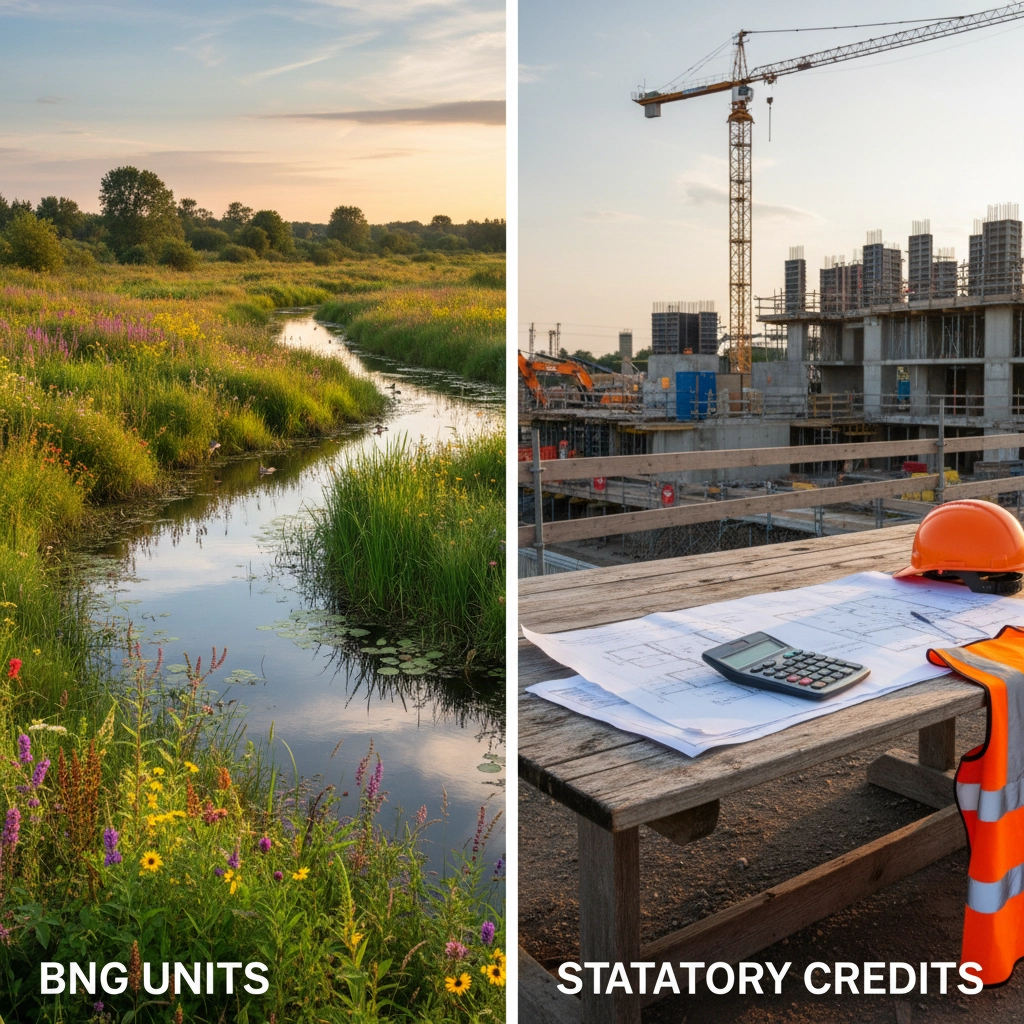
BNG units represent tangible biodiversity value created through habitat enhancement or creation projects on private land. These units are generated by conservation organisations and landowners who actively improve ecological habitats, and they can be purchased on the open market to offset biodiversity losses from your development.
Think of units as purchasing shares in real, measurable habitat improvements: a woodland creation project, wetland restoration, or species-rich grassland establishment. Each unit corresponds to specific biodiversity value that’s been independently assessed and verified.
Statutory biodiversity credits, by contrast, are government-issued instruments sold exclusively by Natural England when you cannot obtain sufficient units through other means. These function as a financial contribution to the government, which later uses the funds for general habitat projects across England with no direct connection to your local area.
Credits represent a regulatory safety net designed to ensure no development is blocked due to unavailable biodiversity units, but they come with significant financial and procedural constraints.
Critical Differences That Impact Your Project
Cost Structure: The £60,000+ Difference
The financial implications are substantial and often decisive. A single statutory credit costs approximately £42,000, but here’s the crucial detail: one credit only equals half a biodiversity unit due to a “spatial risk multiplier” applied by Natural England.
This means achieving one unit of biodiversity value requires purchasing two credits, effectively costing around £84,000 per unit. The government deliberately prices credits higher to avoid undercutting the private market and to discourage their use except when absolutely necessary.
By comparison, off-site units from private providers typically range from £20,000 to £25,000 per unit, making them significantly more economical. For a typical small development requiring 3-4 biodiversity units, the cost difference between units and credits could exceed £200,000.
Regulatory Hierarchy: Not a Free Choice
The regulations establish a clear priority system that you must follow. You cannot simply choose credits because they’re more convenient. The biodiversity net gain hierarchy requires:
- Maximise on-site habitat improvements first
- Seek off-site units from the private market
- Resort to statutory credits only after demonstrating both previous options are genuinely unfeasible
Your Local Planning Authority must approve the use of credits, requiring documented evidence that you’ve exhausted all other reasonable alternatives. This isn’t a tick-box exercise: you need to demonstrate genuine attempts to source units and explain why they weren’t viable.
Environmental Impact: Real Habitats vs. Financial Contributions
Units deliver more direct ecological benefits because they’re tied to specific, tangible habitat creation or enhancement projects, often in your local area. These projects must be registered on the Biodiversity Gain Sites Register and involve actual on-the-ground improvements that you can visit and verify.
Credits represent a payment to the government with no immediate link to a specific local project. The money eventually funds biodiversity enhancements somewhere in England, but the connection to your development’s impact is far more abstract. There’s no guarantee that credit-funded projects will occur in your local area or even within a reasonable timeframe.

Detailed Comparison Analysis
| Aspect | BNG Units | Statutory Credits |
|---|---|---|
| Source | Private market habitat projects | Natural England/government |
| Cost per unit value | £20,000-£25,000 | ~£84,000 (2 credits required) |
| Availability | May be limited locally | Available nationwide |
| Usage priority | Should be used first | Last resort only |
| Local benefit | Direct local habitat improvement | Funds used for general projects |
| LPA approval | Standard planning process | Requires proof of necessity |
| Value conversion | 1 unit = 1 unit | 2 credits = 1 unit |
| Project timeline | Requires sourcing and negotiation | Immediate availability |
| Quality assurance | Third-party verified projects | Government-managed allocation |
Strategic Recommendations by Scenario
Choose BNG Units When:
You have sufficient project lead time to identify and secure appropriate off-site providers. Most successful developments begin BNG planning 6-12 months before planning submission.
Cost efficiency is a priority for your development budget. The potential savings of £60,000+ per unit make this the financially prudent choice for most projects.
You want to demonstrate strong environmental credentials through tangible local habitat improvements. Units allow you to showcase specific conservation outcomes directly linked to your development.
Your project area has reasonable availability of habitat banks or conservation sites that can provide the required habitat types and quantities.
Consider Statutory Credits When:
You’ve genuinely exhausted all on-site and off-site unit options and can document this comprehensively to your Local Planning Authority. This documentation must be thorough and credible.
Your project is in an area with extremely limited availability of off-site units, particularly for specialist habitat types or in regions with few conservation providers.
Project timelines are critical and securing private units proves impossible despite reasonable efforts. However, remember that LPA approval for credits may add its own delays.
The specific habitat types you need to offset are particularly rare or difficult to source, such as certain priority habitats or habitats supporting protected species.

Best Practice Implementation Strategy
Start Early and Plan Comprehensively. Begin your BNG planning during the feasibility stage, not when preparing planning applications. Early engagement with biodiversity net gain consultants allows time to explore all options and avoid expensive credit requirements.
Conduct Thorough Market Research. Systematically identify potential off-site providers within reasonable distance of your development. Document your search process meticulously, as this evidence may be crucial if you later need to justify credit usage to your LPA.
Engage Professional Expertise. Work with qualified ecologists to use the Biodiversity Metric 4.0 calculator accurately. Incorrect calculations can lead to purchasing insufficient units or credits, creating compliance issues later.
Negotiate Early Agreements. Once you’ve identified suitable unit providers, consider securing options or preliminary agreements early in your development process. This protects against units being sold to other developments and provides cost certainty.
Document Everything. Maintain detailed records of your BNG sourcing efforts, including communications with potential providers, site visits, and reasons for rejecting various options. This documentation is essential if you need LPA approval for credit usage.
The Commercial Reality
For most developers, the choice between units and credits isn’t really a choice at all: it’s a consequence of planning. Well-planned developments use units; poorly planned ones pay premium prices for credits.
The fundamental principle is straightforward: statutory credits exist as a safety net to ensure developments can always proceed even when market-sourced units aren’t available, but they’re intentionally designed to be the less favourable option in terms of both cost and environmental value.
The key to success is early engagement and professional guidance. Developments that begin BNG planning early virtually eliminate the need for expensive statutory credits, while those that leave it to the last minute often find themselves with limited options and premium costs.
If you’re beginning a development project and need guidance on BNG compliance, professional biodiversity net gain consultation can help you navigate these choices effectively and avoid costly mistakes. The investment in proper planning typically pays for itself many times over through the avoidance of credit purchases and the selection of optimal unit sources.
Understanding these differences and planning accordingly isn’t just about regulatory compliance: it’s about making informed commercial decisions that benefit both your project economics and environmental outcomes.