
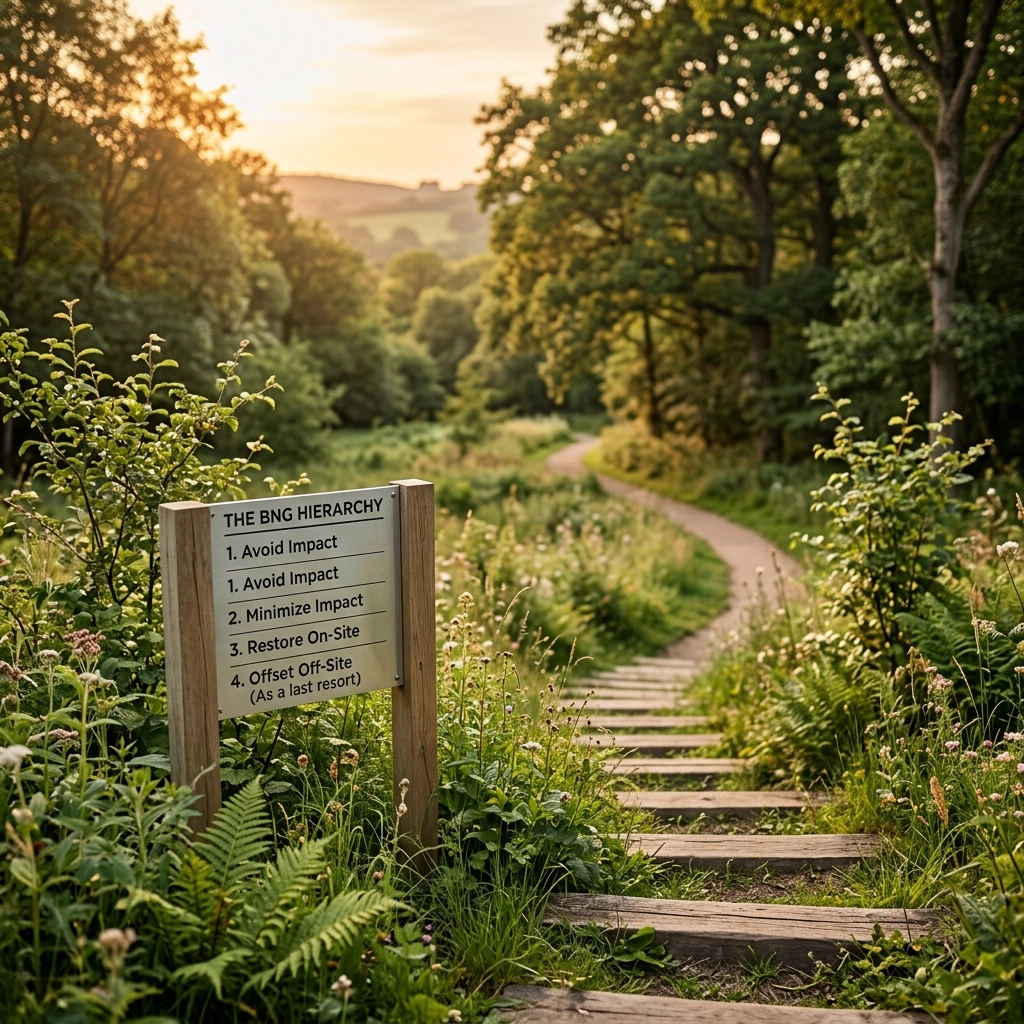
If you’re a developer, architect, or landowner in the UK, you’ve likely spent the last few years getting your head around Biodiversity Net Gain (BNG). Since it became mandatory for most developments, the conversation has often revolved around the “10% rule.” But there is another rule that is arguably more important, and it’s one that catches people out constantly: the BNG Hierarchy.
At The BNG Guy, we speak to developers every week who assume that BNG is a “pay-to-play” system. The logic usually goes like this: “I want to build on the whole site, so I’ll just calculate the loss and buy some biodiversity units to fix it.”
While we’d love to tell you it’s that simple (especially since we sell habitat units), the law actually says the opposite. You can’t just skip to the end of the checkbook. There is a very specific order of operations you must follow, and if you ignore it, your planning application is going to hit a brick wall.
What is the BNG Hierarchy?
The BNG hierarchy is a sequential process designed to ensure that the most valuable nature is protected first. It isn’t just “best practice”: it is a legally binding framework under the Environment Act 2021. You have to prove to the Local Planning Authority (LPA) that you have tried each step before moving to the next.
Think of it like a ladder. You can’t reach the top (buying units) without stepping on the rungs below first.
Step 1: Avoidance (The Gold Standard)
The best way to achieve BNG is to not lose biodiversity in the first place. This means looking at your site’s baseline and designing your layout to avoid the high-value habitats. If there is an ancient hedgerow or a specific area of woodland, don’t build on it. By avoiding the “good stuff,” you keep your baseline high and your “debt” low.
Step 2: Minimisation
If you absolutely have to build on or near a habitat, how can you make the impact as small as possible? This might involve changing the footprint of a building, using “green” infrastructure, or timing works to avoid disturbing local wildlife.
Step 3: On-site Restoration and Enhancement
Once you’ve avoided and minimised what you can, the next step is to fix what’s left. If you have a degraded area of grassland on-site, can you restore it to a “Good” condition? Enhancing existing habitat is often the most cost-effective way to gain units.
Step 4: On-site Creation
If restoration isn’t enough, you look at creating new habitats within your “red line” boundary. This could be anything from planting new native trees to installing SuDS (Sustainable Drainage Systems) that double as wildlife ponds.
Step 5: Off-site Biodiversity Units
Only after you have exhausted the on-site options can you look at buying bng units for sale from a third party or using your own land elsewhere. This is the “offsetting” stage.
Step 6: Statutory Credits (The Nuclear Option)
If you can’t find units on the private market, you can buy “Statutory Credits” from the government. However, these are priced intentionally high (often double the market rate) to encourage developers to use steps 1 through 5 first.

Why It’s Not a “Pay to Play” System
One of the biggest misconceptions in the industry is that BNG is a tax. It’s not. It’s a design requirement.
If you submit a planning application that shows 0% on-site gain and 100% off-site units, the LPA is going to ask for a very detailed explanation as to why you couldn’t do more on-site. If your answer is simply “it’s more profitable to build more houses,” you’re going to have a hard time.
The biodiversity net gain consultants we work with always emphasize that the hierarchy is the first thing an planning officer looks at. They want to see that you’ve tried to integrate nature into your development. Buying your way out is a last resort, not Plan A.
The 30-Year Reality Check
When you do commit to on-site BNG: whether through restoration or creation: you aren’t just planting a few trees and walking away. You are signing up for a 30-year legal commitment.
This is the part that often surprises developers. To ensure those habitats actually thrive, you will need:
- A Habitat Management and Monitoring Plan (HMMP): A detailed document outlining exactly how the land will be managed for three decades.
- Legal Agreements: Usually a Section 106 agreement or a Conservation Covenant that binds the land.
- Regular Monitoring: Professional ecologists (like us!) will need to visit the site at years 2, 5, 10, 15, 20, 25, and 30 to prove the habitat is reaching its target condition.
- Funding: You need to put aside the cash to pay for 30 years of gardening, basically.
This is why some developers eventually decide that off-site biodiversity units uk are actually the “cleaner” break. While the hierarchy says you must try on-site first, if the on-site management is going to be impossible or a liability for the future residents (who wants to pay a massive service charge for a specific type of rare wildflower meadow?), then the off-site route becomes a justified alternative.

Why Early Design Saves You A Fortune
We can’t scream this loud enough: Get your ecology surveys done before you fix your layout.
If you design your housing estate and then call in the biodiversity net gain consultants, you are playing a dangerous game. You might find out that you’ve placed a driveway right through a “Medium Distinctiveness” habitat. Because of the hierarchy, you now have to prove why you couldn’t move that driveway. If you can’t, you might have to redesign the whole site, costing thousands in architect fees.
By doing a baseline survey early, we can tell you where the “low-value” spots are. Build there, save the “high-value” spots for your open space requirements, and your BNG bill drops significantly.

Navigating the Hierarchy with The BNG Guy
At The BNG Guy, we don’t just sell units; we help you navigate the entire journey from survey to sign-off. We understand the pressure developers are under to deliver viable projects while meeting these new, complex environmental standards.
Our process is built around the hierarchy:
- Baseline Surveys: We use the latest UKHAB standards to tell you exactly what you have on-site.
- Design Advice: We work with your architects to “design out” the high-cost BNG areas.
- HMMP Creation: We write the management plans that keep the LPAs happy.
- Off-site Sourcing: If you’ve followed the hierarchy and still need units, we provide high-quality, pre-registered habitat units from our own land banks.
Whether you are dealing with a small site (and looking at the new 0.2-hectare exemptions) or a major infrastructure project, the rules of the hierarchy remain the same.
Summary: How to Get it Right
- Don’t assume you can buy units immediately. The LPA will check your working.
- Respect the sequence. Avoid, then Minimise, then Restore, then Offset.
- Budget for the 30-year tail. On-site BNG is a long-term liability.
- Start early. Ecology should be your first port of call, not an afterthought.
If you’re feeling overwhelmed by the technicalities of the Metric 4.0 or the legalities of the hierarchy, don’t sweat it. That’s what we’re here for. We make the ecology side of things as painless as possible so you can get back to building.
Need a hand with your BNG strategy? Check out our latest news for updates on policy changes, or get in touch for a BNG assessment.
